Wat is lead management?

Geen tijd?

Geen tijd om te lezen? Heb je vandaag haast? Ik heb de belangrijkste punten van deze blog voor je samengevat.

  • Leadbeheer is het proces van het vastleggen, kwalificeren en nurturen van potentiële klanten (of leads) totdat ze klaar zijn om te kopen.
  • Het beheren van leads kan je bedrijf helpen om de verkoop en inkomsten te maximaliseren, tijd en middelen te besparen en klantrelaties te verbeteren. Het is ook een uitstekende manier om bedrijfsontwikkeling te ondersteunen door je te helpen meer leads te beheren naarmate je groeit.
  • Er zijn verschillende soorten leads in een leadbeheersysteem, waaronder warme leads, koude leads, IQL’s, MQL’s, SQL’s en PQL’s.
  • Leadbeheer is een cyclisch proces dat bestaat uit 7 belangrijke stadia: leadgeneratie, leadsegmentatie, leadkwalificatie, lead nurturing, lead scoring en routing, opvolging, meten en optimaliseren.
  • Verbeter je leadbeheerproces door de ‘best practices’ te volgen, zoals het prioriteren van leadkwaliteit boven kwantiteit, het gebruik van automatiseringssoftware, het schoonhouden van je database en het her activeren van oude of dode leads.
  • Er zijn veel CRM-systemen die je kunt gebruiken voor het vastleggen van leads, maar Microsoft Dynamics 365 Sales is natuurlijk de beste.

Wat is leadbeheer?

Leadbeheer is het proces van het vastleggen, kwalificeren en nurturen van potentiële klanten (of leads) totdat ze klaar zijn om te kopen. Het draait allemaal om het aantrekken van de juiste prospects, het begrijpen van hun behoeften, het leveren van gepersonaliseerde inhoud, het opvolgen met de juiste timing en het effectief distribueren van kansen naar je verkoopteam. Uiteindelijk is het doel om je marketing- en verkoopproces te stroomlijnen en meer leads om te zetten in kopende klanten.

Voordelen van leadbeheer

Natuurlijk kun je achterover leunen en de leads afhandelen zodra ze binnenkomen. Het opzetten van een leadbeheerproces kan echter meerdere voordelen bieden voor je bedrijf.

Waarom is het essentieel om met je verkoopteam samen te komen en een strategie te ontwikkelen voor het efficiënt afhandelen van leads?

  • Verhoog de verkoop en winst: Het nastreven van de juiste leads en het nurturen ervan met specifieke strategieën zal je conversieratio’s natuurlijk verhogen. Hoe meer klanten je converteert, hoe hoger je inkomsten zullen zijn.
  • Bespaar tijd en middelen: Door leads te rangschikken op basis van hun potentieel, kun je je tijd, budget en energie optimaal inzetten. Deze aanpak voorkomt dat je inspanningen verspreidt over alle leads, waardoor je je kunt concentreren op degenen met een hogere kans op conversie.
  • Verbeter klantrelaties: Effectief leadbeheer stelt je in staat om de banden met potentiële klanten te versterken door relevante, tijdige en gepersonaliseerde communicatie te bieden. Deze aanpak vormt ook de basis voor langdurige klantloyaliteit en een hogere levenslange waarde.
  • Ondersteun bedrijfsontwikkeling: Het implementeren van een leadbeheersysteem stelt je bedrijf in staat om efficiënter te groeien. Je kunt grotere hoeveelheden leads beheren terwijl je kwaliteit en personalisatie behoudt.

Soorten leads

In je leadbeheersysteem kom je verschillende soorten leads tegen. Het is essentieel om ze te organiseren en te prioriteren op basis van hun interesse- en kwalificatieniveaus.

Hier zijn de belangrijkste soorten leads die je bedrijf kan tegenkomen:

Op basis van interesse

  • Koude leads: Individuen of bedrijven die niet op de hoogte zijn van je bedrijf en geen interesse tonen in je producten of diensten.
  • Warme leads: Deze hebben interactie gehad met je inhoud of je website bezocht, maar zijn nog niet klaar om te kopen.
  • Hete leads: Zeer geïnteresseerd en klaar om te kopen; ze hebben mogelijk een offerte, demo of consultatie aangevraagd.

Op basis van kwalificatie

  • Information Qualified Leads (IQL’s): Deze leads ruilen hun contactgegevens voor iets waardevols zoals een whitepaper of webinar. Ze tonen interesse, maar zijn nog niet klaar om met sales te praten.
  • Marketing Qualified Leads (MQL’s): Leads die hebben gereageerd op je marketinginspanningen en aan specifieke criteria voldoen, waardoor ze potentiële klanten zijn.
  • Sales Qualified Leads (SQL’s): Toegewezen aan het salesteam, deze leads zijn klaar voor een verkoopgesprek en tonen sterke interesse.
  • Product Qualified Leads (PQL’s): Leads die je product hebben gebruikt via proefversies of freemium-modellen en een hoge betrokkenheid tonen, wat aangeeft dat ze waarschijnlijk betalende klanten worden.

7 Stadia van leadbeheer

We kunnen het leadbeheerproces in 7 verschillende stadia verdelen:

  1. Leadgeneratie: Het aantrekken en vastleggen van de interesse van je doelgroep, meestal door hen iets waardevols aan te bieden in ruil voor hun contactgegevens. Het dient als de cruciale eerste stap in het vullen van je verkoopkanaal met potentiële klanten.
  2. Leadsegmentatie: Het proces van het verdelen van prospects in verschillende groepen op basis van specifieke kenmerken, gedragingen of behoeften.
  3. Leadkwalificatie: Het proces van het beoordelen hoe waarschijnlijk het is dat een lead een klant wordt op basis van specifieke criteria.
  4. Lead nurturing: Het ondersteunen van leads door middel van campagnes die zijn ontworpen om hen te informeren, betrekken en begeleiden door de verkoopfunnel.
  5. Lead scoring & routing: Het toekennen van waarden aan elke lead op basis van factoren zoals hun interesse- en betrokkenheidsniveau en hoe goed ze passen bij je ideale klantprofiel.
  6. Leadconversie: Het moment waarop een prospect besluit om al dan niet een aankoop te doen.
  7. Meten & optimaliseren voor succes: Het voortdurend meten, analyseren en optimaliseren van elk stadium van het leadbeheerproces om de resultaten te maximaliseren.

Leadgeneratie

Lead generatie houdt in dat je de interesse van je doelgroep aantrekt en vastlegt, meestal door hen iets waardevols aan te bieden in ruil voor hun contactgegevens. Dit is de cruciale eerste stap in het vullen van je verkoopkanaal met potentiële klanten. Zonder effectieve leads generatie zijn er geen prospects om te nurturen of om te zetten in klanten.

Hier zijn enkele manieren om leads te genereren, afhankelijk van je branche en publiek:

  • Schrijf en deel je blogs
  • Stuur een e-mailnieuwsbrief
  • Organiseer webinars
  • Deel whitepapers
  • Verkoop via sociale media op LinkedIn

De sleutel tot succesvolle leads generatie is het bieden van echte waarde. Of het nu gaat om inzichtelijke blogs, boeiende social media posts of aantrekkelijke leadmagneten, je moet je richten op het leveren van oplossingen en informatie die aansluiten bij de behoeften en uitdagingen van je doelgroep.

Het verbeteren van het proces rondom het verzamelen van leads is net zo belangrijk als het verhogen van het verkeer. Zorg ervoor dat je landingspagina’s, formulieren en call-to-actions (CTA’s) duidelijk, aantrekkelijk en gemakkelijk te gebruiken zijn. Test verschillende ontwerpen, berichten en aanbiedingen om te ontdekken wat de beste conversiepercentages oplevert.

Leadsegmentatie

Met al die binnenkomende leads heb je nu een systeem nodig om ze te organiseren. Lead segmentatie is het proces van het verdelen van prospects in afzonderlijke groepen op basis van specifieke kenmerken, gedragingen of behoeften.

Je kunt bijvoorbeeld afzonderlijke lijsten maken op basis van waar je leads vandaan komen:

  • Hebben ze zich ingeschreven voor je e-mailnieuwsbrief?
  • Hebben ze contact opgenomen met de klantenservice?
  • Of hebben ze je whitepaper gedownload?

Segmentatie stelt je in staat om je inspanningen voor het nurturen van leads te prioriteren en je berichten beter af te stemmen op de specifieke behoeften van elke groep. Zo kun je bijvoorbeeld opvolgen met leads die contact hebben opgenomen met de klantenservice door te vragen naar hun ervaring of verdere hulp aan te bieden. Voor leads die een white paper hebben gedownload, kun je aanvullende bronnen delen of een oplossing voor hun probleem aanbieden.

B2B-bedrijven kunnen leads segmenteren op basis van factoren zoals branche, bedrijfsomvang, beslisserrol of fase in de funnel. Daarentegen kunnen B2C-merken zich richten op demografische gegevens van kopers, eerdere aankopen of browsegedrag.

Door in de gegevens van je CRM en marketingautomatiseringstools te duiken, kun je verfijndere segmenten maken. Analyseer hoe verschillende segmenten omgaan met je website en content, en identificeer patronen of gedeelde kenmerken onder je leads.

Leadkwalificatie

Het genereren van een groot aantal leads is geweldig, maar als die leads geen goede match zijn voor je bedrijf, verspil je waarschijnlijk waardevolle tijd en middelen. Hier komt leadkwalificatie in beeld, het proces van het beoordelen hoe waarschijnlijk het is dat een lead klant wordt op basis van specifieke criteria.

De definitie van een “gekwalificeerde” lead verschilt echter per bedrijf. Een veelgebruikte methode om leads te kwalificeren is het BANT-framework, dat rekening houdt met:
• Heeft de lead het budget voor je oplossing?
• Hebben ze de mogelijkheid (ability) om beslissingen te beïnvloeden of te nemen?
• Hebben ze een echte behoefte (need) aan je product of dienst?
• Wat is hun koopplanning (timeline)?

Als een lead niet aan je criteria voldoet, worden ze als “ongekwalificeerd” beschouwd, wat betekent dat ze geen goede match zijn voor je bedrijf en waarschijnlijk niet zullen converteren, ondanks je beste marketing- en verkoopinspanningen. Het niveau van kwalificatie kan ook variëren, leads kunnen informatiegekwalificeerd, marketinggekwalificeerd, verkoopgekwalificeerd of productgekwalificeerd zijn.

Om de nodige kwalificatie-informatie te verzamelen, moeten marketing- en verkoopteams samenwerken. Begin met het opnemen van belangrijke vragen in je leadformulieren. Een B2B-softwarebedrijf kan bijvoorbeeld vragen naar de bedrijfsomvang, rol en huidige softwaretools.

Naarmate leads door de funnel bewegen, kun je gebruikmaken van contactmomenten zoals enquêtes of telefoongesprekken om hun geschiktheid en gereedheid verder te beoordelen. Houd er rekening mee dat leads kwalificatie een doorlopend proces is. Naarmate je meer informatie verzamelt, kan de kwalificatiestatus van een lead evolueren.

Lead nurturing

De meeste leads zijn niet meteen klaar zijn om een aankoop te doen. Ze hebben tijd nodig om te onderzoeken, opties te evalueren en vertrouwen in je bedrijf op te bouwen.

Ondersteun hen met leads nurturing campagnes die zijn ontworpen om prospects te informeren, te boeien en hen door de verkoopfunnel te begeleiden, van eerste interesse tot het moment van aankoop.

Effectief leads nurturen houdt in dat je relevante, waardevolle content levert die is afgestemd op elke fase van de koopreis. Dit kan omvatten:

  • Blogs
  • E-mailcampagnes
  • Social media posts
  • Webinars
  • Casestudies

Zorg ervoor dat je lead nurturing campagnes prospects via meerdere kanalen bereiken en gepersonaliseerd zijn voor elke potentiële klant. Terwijl het handmatig beheren hiervan een uitdaging kan zijn, kan Dynamics 365 Customer Insights het proces stroomlijnen.

Vergeet niet dat lead nurturing niet stopt bij de aankoop. Het strekt zich uit voorbij conversie, waarbij de focus ligt op het onderhouden van klantrelaties en het bevorderen van loyaliteit, herhaalde aankopen en positieve mond-tot-mondreclame.

Lead scoring & routing

Leads scoring houdt in dat je punten toekent aan elke lead op basis van factoren zoals hun mate van interesse, betrokkenheid bij je bedrijf en hoe goed ze aansluiten bij je ideale klantprofiel.

Werk samen met je team om te bepalen wat een lead verkoopklaar maakt en stel scoringsdrempels in die de overgang van marketing naar verkoop activeren. Zodra een lead die drempel bereikt, zorgt lead routing ervoor dat ze worden toegewezen aan de juiste verkoopvertegenwoordiger.

Leadconversie

De conversiefase is waar al je harde werk in het genereren, nurturen en kwalificeren van leads zijn vruchten afwerpt. Dit is het moment van de waarheid wanneer een prospect besluit of hij wel of niet een aankoop doet.

Maar naast de verkoop is dit ook een kans om de basis te leggen voor een langdurige klantrelatie. Door een naadloze, positieve verkoopervaring te bieden en je beloftes na te komen, kun je een eenmalige koper omzetten in een loyale klant, en zelfs in een ambassadeur.

Niet elke lead zal bij de eerste poging converteren. Sommige leads hebben meer tijd, informatie of overtuiging nodig voordat ze bereid zijn om zich te committeren. Hier wordt effectieve opvolging cruciaal.

Stuur tijdige, relevante en consistente opvolgingsberichten om ervoor te zorgen dat je bedrijf top-of-mind blijft. Train je verkoopmedewerkers om actief te luisteren, inzichtelijke vragen te stellen en nuttige begeleiding te bieden, zonder te hard te pushen voor een snelle verkoop.

Wees attent op de tijd en interesse van je lead. Varieer je contactmethoden. Als een e-mail onbeantwoord blijft, probeer dan contact op te nemen via LinkedIn. Als een lead koud is geworden, probeer ze dan later opnieuw te benaderen met verse content of een nieuw aanbod.

Tactieken voor optimalisatie van het conversiepercentage kunnen hier ook van onschatbare waarde zijn. Analyseer waarom leads afhaken en identificeer verbeterpunten. Misschien moet je je afrekenproces vereenvoudigen, je call-to-actions verbeteren of je formulieren inkorten. Blijf verschillende aspecten van je verkoopfunnel continu testen en optimaliseren om conversies in de loop van de tijd te verbeteren.

Meten & optimaliseren voor succes

Leadbeheer is geen eenmalige inspanning. Om de resultaten te maximaliseren, vereist het voortdurende meting, analyse en optimalisatie in elke fase van de funnel.

Begin met het vaststellen van duidelijke KPI’s voor elke fase van je leadbeheerproces. Belangrijke statistieken kunnen zijn:

  • Aantal gegenereerde leads
  • Conversiepercentages tussen fasen
  • Reactietijden op leads
  • Totale of toegeschreven omzet

Analyseer hoe leads uit verschillende bronnen door de funnel bewegen, identificeer belangrijke conversiepunten en markeer de fasen waar leads vaak vastlopen of afhaken. Onderzoek daarnaast hoe verschillende leadsegmenten presteren om te bepalen welke het meest waarschijnlijk zullen converteren.

Deze gegevens vormen de basis voor optimalisatie. Als bijvoorbeeld leads via sociale media niet genoeg conversies opleveren, moet je je strategie daar mogelijk aanpassen. Als bepaalde segmenten hogere conversiepercentages hebben, overweeg dan om meer te focussen op het aantrekken van vergelijkbare leads. Het creëren van ideale klantprofielen of buyer personas kan je helpen om de juiste doelgroep effectief te bereiken.

Kwantitatieve gegevens alleen zijn niet voldoende. Verzamel regelmatig feedback van je verkoopteam om te begrijpen welke bezwaren vaak voorkomen, welke content of gesprekspunten aanslaan, en wat marketing zou kunnen doen om hun inspanningen beter te ondersteunen. Vraag ook klanten om hun input: Waarom kozen ze voor jouw oplossing? Wat had hen bijna weerhouden van een aankoop?

Gebruik deze feedback om elk aspect van je leadbeheerproces continu te optimaliseren. A/B-test landingspagina’s, formuliervelden of leadmagneten. Experimenteer met verschillende leadsegmenten of scoringsmodellen. Pas je nurturing-sequenties en verkoopgesprekken aan op basis van betrokkenheidsgegevens en inzichten uit feedback.

Best practice voor leadbeheer

Leadbeheer biedt tal van voordelen, van het verhogen van de verkoop en winst tot het stimuleren van bedrijfsontwikkeling. Om je leadbeheerstrategie echter echt te maximaliseren, houd je deze tips en beste praktijken in gedachten:

  • Focus op leadkwaliteit boven kwantiteit: Hoewel het aantrekkelijk kan zijn om een groot aantal leads te genereren, is het waardevoller om hoogwaardige leads aan te trekken die goed passen bij je bedrijf.
  • Gebruik automatiseringssoftware: Investeren in leadbeheer- en marketingautomatiseringstools kan je verkoopproces aanzienlijk stroomlijnen en de efficiëntie verbeteren.
  • Onderhoud een schone database: Na verloop van tijd kan je leaddatabase rommelig worden met duplicaten, verouderde informatie en inactieve contacten. Houd je database regelmatig schoon om ervoor te zorgen dat je inspanningen gericht zijn op actieve, relevante leads.

Heractiveer inactieve leads: Een lead die aanvankelijk niet converteerde, is niet per definitie een verloren kans. Stel een proces in om slapende of gediskwalificeerde leads op een later tijdstip opnieuw te betrekken.
Sales Force Automation

The role of a salesperson has significantly changed. What once consisted of a few phone calls and face-to-face meetings now encompasses everything from targeted emails to spontaneous online chats. Organizations rely on both digital salespeople and “field sales” and “customer success champions” to support their customers throughout the entire sales process.

Since the pandemic, working from home has become normal, and with shrinking travel budgets, salespeople need technology to connect with colleagues across different data sources and with customers.

One of the characteristics of a salesperson is the desire to be as productive as possible. Building connections and maintaining relationships without sacrificing productivity is an important goal. According to the Microsoft Work Trend Index, salespeople spend more than 66 percent of their day managing emails, leaving only about a third of their time for actual sales activities.

SFA and productivity solutions come together in Dynamics 365 Sales, a solution that focuses on collaboration, productivity, AI, and insights, allowing salespeople to focus on closing deals. Dynamics 365 Sales integrates seamlessly with Microsoft Teams to enable communication for collaboration and alignment between marketing, sales, and service departments.

In addition, Copilot brings next-generation AI to collaboration apps like Outlook and Teams, allowing salespeople to work more productively, whether they are using Dynamics 365 Sales or Microsoft 365 apps. Manual input disappears, summaries are provided, and time-consuming processes are “outsourced.” This gives salespeople more time to build and maintain customer relationships, ultimately resulting in increased sales.

When looking at Sales Force Automation, we can distinguish the following:

  • Account & contact management
  • Contact moments
  • Lead management
  • Opportunity management
  • Products and price lists
  • Quote, order, and invoice management

Account management

Within Dynamics 365 Sales, you use accounts to store information about the companies you do business with. In addition to storing customers, you can also store other types of relationships, such as suppliers, partners, or government agencies, in Dynamics 365 Sales. Easy categorization and filtering options ensure that you can easily differentiate between the different types of relationships.

Contacts are the people you work with within the aforementioned companies. You can add multiple contacts to an account, but only one account can be linked to a contact. You can create accounts and contacts manually or import them from (for example) a spreadsheet.

Contact moments

Your entire organization has contact with your customers and the contacts who work there. To ensure that valuable information doesn’t remain locked in your employees’ minds, it’s important to make it easy for people to record each contact moment in CRM. Whether it’s a phone call, an email, an appointment, or a Teams chat.

One of the most valued features is the seamless integration between Outlook and Dynamics 365 Sales. This makes it easy to save email communications in your CRM system without leaving Outlook.

SFA within Dynamics 365 Sales gives your organization the ability to centralize all contact moments so that, when an employee leaves your organization, no time is lost gathering the information built up over years in personal mailboxes, among other places.

Lead management

Lead management is a crucial part of any successful business. The process includes generating, qualifying, tracking, and converting potential customers (leads) into actual customers. A CRM system plays an essential and central role in this.

A CRM system is the central hub for all generated leads from various sources, such as website forms, social media, email campaigns, and events. By collecting leads in one central place, a marketing department can easily and clearly edit and track the leads.

A CRM system enables personalized nurturing for leads that aren’t yet ready to buy. Through targeted emails, follow-up actions, and relevant content, companies can keep leads warm and guide them through the different stages of the sales cycle.

When a lead becomes a Sales Qualified Lead (SQL), all collected information is automatically transferred to the sales opportunity.

Opportunity management

Opportunity management is a core part of an effective sales strategy, consisting of identifying, developing, and closing sales opportunities. SFA within CRM provides the tools and insights needed to optimize this process.

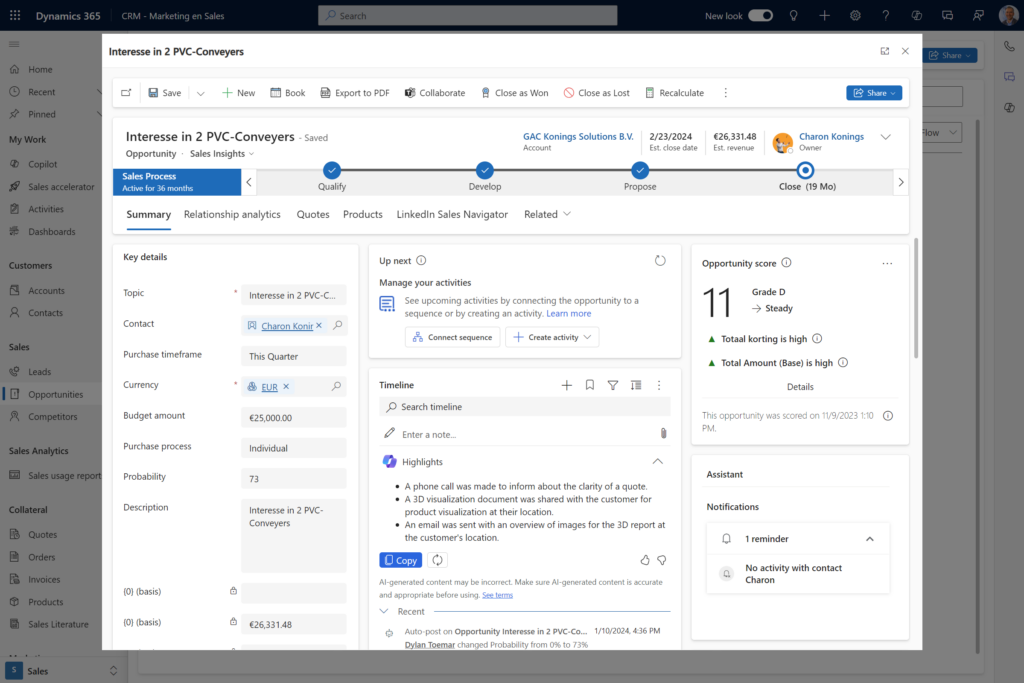
A Customer Relationship Management (CRM) system plays a crucial role in this process by providing the tools and insights needed to manage and maximize sales opportunities effectively. Within a CRM system, sales opportunities are recorded in detail, including key information such as the value of the opportunity, the expected close date, involved products or services, and the stage of the sales process. This allows each opportunity to be tracked accurately, leaving nothing to chance.

One of the biggest advantages of SFA is the ability to visually manage the sales pipeline. Salespeople can see at a glance which stage each opportunity is in, helping to identify bottlenecks and optimize the sales process. By having a clear and up-to-date pipeline, companies can be more predictable, and other departments within a company can plan in detail.

A CRM system also automates many aspects of opportunity management, such as sending reminders for outstanding actions, assigning tasks to team members, and generating reports. This reduces the administrative burden and allows sales teams to focus on closing deals.

A CRM system ensures optimal collaboration and communication within sales departments. All team members have access to the same information about sales opportunities, ensuring a coordinated and structured approach. This is especially important for complex and long-term sales processes involving multiple team members.

Using the analytics features of a CRM system, companies can gain valuable insights into their sales opportunities. They can identify trends and patterns, such as which types of opportunities have the highest conversion rates or which stages of the sales cycle are the most challenging. These insights help refine the sales strategy.

By centralizing all information about sales opportunities in one place, sales teams can adopt a more customer-centric approach. They have a complete picture of the customer’s needs and preferences, allowing them to make personalized and relevant offers. This increases the chance of success and enhances customer satisfaction.

A CRM system makes it easy to measure and track the performance of sales opportunities. Companies can set and monitor key performance indicators (KPIs), such as the conversion rate, average sales cycle duration, and the total value of opportunities in the pipeline. Sales targets can also be set at both team and individual levels. These metrics are crucial for evaluating the effectiveness of the sales strategy and making data-driven decisions.

Products and price lists

As an organization, you sell products or services that are part of a sales opportunity. As an organization, you want to document your products and services in a structured way so that you can use them in CRM.

The product catalog is part of SFA within Dynamics 365 Sales. Here you can register all the products and services your organization wants to offer to the market in a structured way. Bundling products, prices, and discounts are standard features of the product catalog.

By easily including products in a sales opportunity, you can quickly gain insights into which products are successfully sold within your organization.

Quote, order, and invoice management

A quote is a document in which an organization makes an offer to a potential customer based on the products or services linked to a sales opportunity. A quote typically contains information such as the description, quantity, price, and validity of the offer. A CRM system makes it possible to quickly and easily create quotes using pre-defined Word templates and data from the product catalog and sales opportunity. A quote can then be emailed directly from the CRM system to the customer.

SFA supports the entire sales process, including incoming orders. An order confirms the sales transaction and indicates that the customer is willing to pay. An order can also be created in the CRM system if no quote was sent, such as when a customer calls directly to place an order.

An invoice is a document in which you, as an organization, request payment from the customer for the delivered products or services. An invoice contains information such as the invoice number, invoice date, due date, total amount, and payment terms. A CRM system is not a financial system, so we often see an integration with an ERP system. However, in a CRM system, invoices can also be automatically generated based on the data from the order and sales opportunity, without having to manually re-enter information.

SFA is indispensable for an ambitious sales organization. In this blog, I have explained what SFA is and what it consists of. Finally, I would like to briefly take you through the 10 most important consequences for your organization if you embrace SFA:

  • More insight into customer data
  • Improved customer interactions
  • Reduced administrative tasks
  • Increased sales productivity
  • Better sales forecasts
  • Faster reporting and analysis
  • More efficient data entry
  • Automated workflow processes
  • Consistent sales methodology
  • Improved sales conversion rates

The key to success in the modern sales world

The most successful salespeople do not rely on chance. They are disciplined in building relationships, maintaining the sales pipeline, and automating processes. In this blog, we discuss how sales engagement can help make your daily routine more productive and boost your sales.

Why is Sales Engagement Important?

Sales engagement is not just a buzzword; it is an essential component of a company’s successful sales strategy. By actively and strategically communicating with customers, sales teams can achieve three very important things.

  • Accelerate sales: By communicating quickly and relevantly with customers, they move faster through the sales funnel, allowing you to convince them to make a purchase more quickly.
  • Build relationships: Strong and personalized communication helps in building long-term customer relationships.
  • Increase revenue: An effective sales engagement strategy ensures higher revenue and greater customer satisfaction, securing long-term revenue.

Core Aspects

Now that you know why sales engagement is important, let’s walk you through the key elements.

Channel

Sales engagement utilizes all possible communication channels such as email, phone, social media, and face-to-face meetings, all with the goal of communicating with customers. The aim is to reach customers through the channel they prefer and to approach them at the right moments.

Message

Communicating can be done through many channels, but ultimately it’s about the message. It’s important that it contains valuable and relevant content. This could be product information, an invitation for a demo, a case study, or a customer success story. The goal is to provide customers with the information they need to make a purchase decision.

A crucial part of the message is personalizing the communication. This means understanding the customer’s unique needs and pain points and responding with tailored communication.

Balance

It’s crucial to find the right balance in how often and when you contact customers. Too much contact can be perceived as intrusive, while too little contact can lead to loss of interest. Sales engagement platforms help sellers find this balance by providing data and insights.

Technology

A CRM system like Dynamics 365 Sales has become indispensable for a successful sales team. Sales engagement is part of the Dynamics 365 Sales Enterprise license and includes several highly valuable features to support the three core aspects (channel, message, and frequency).

Business Card Scanner

To record communication with your customers in a CRM system, it’s convenient to have the contacts you’re interacting with available in CRM. While you can manually enter contacts, you can also use the built-in business card scanner in the mobile app. Simply scan the card, and the text is automatically converted into the appropriate fields for a contact person.

Email Engagement

With email engagement, you can send emails directly from Dynamics 365 Sales. By simply creating a new email interaction, you can send an email right away. Personalized templates allow you to convey the right message. But that’s not all. You can track the recipient’s activity and set reminders if an email hasn’t been opened or answered. Additionally, you gain complete insight into the recipient’s interaction with your email, including how often the email has been viewed and whether attachments have been clicked.

Auto Capture

This feature helps you automatically record activities such as emails and meetings (found in Outlook) and display them on the Dynamics 365 Sales timeline. Auto capture recognizes relevant emails and meetings in your personal Outlook account and shows them as suggestions on the timeline of the corresponding record in Dynamics 365 Sales. Initially, automatically captured activities are only visible to you. You can choose to track these activities, making them visible to the entire sales team. This functionality works seamlessly with your existing Exchange and Outlook accounts, eliminating the need for manual entry. Additionally, you gain insight into your customers’ interactions, seeing exactly if a sent email has been opened, read, and whether an attachment has been opened. If you haven’t received a response to a sent email, you’ll get a subtle notification in your CRM system.

(Advanced) Proactive Assistant

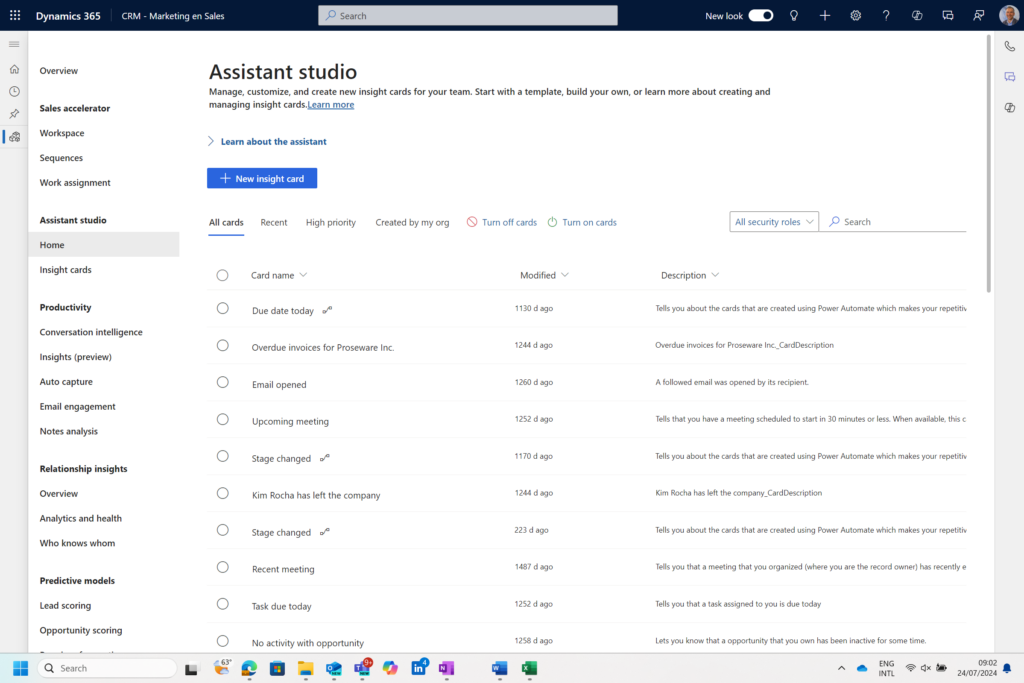
The standard proactive assistant comes with a set of ready-to-use notification cards that you can configure according to your preferences. For example, if you haven’t had contact with a customer for a while, if a sales opportunity is nearing its closing date, or if you haven’t received a response to a sent email. The most requested notifications have been made available by Microsoft by default. With the advanced proactive assistant, you can not only choose which notifications you want to see, but you can also design them yourself. You do this from the Assistant Studio. You create a custom notification card with the help of Power Automate. This allows you to use any important event or date as a notification for the user. By utilizing Power Automate’s connectors, you can even create notifications based on events in external applications.

Sales Accelerator

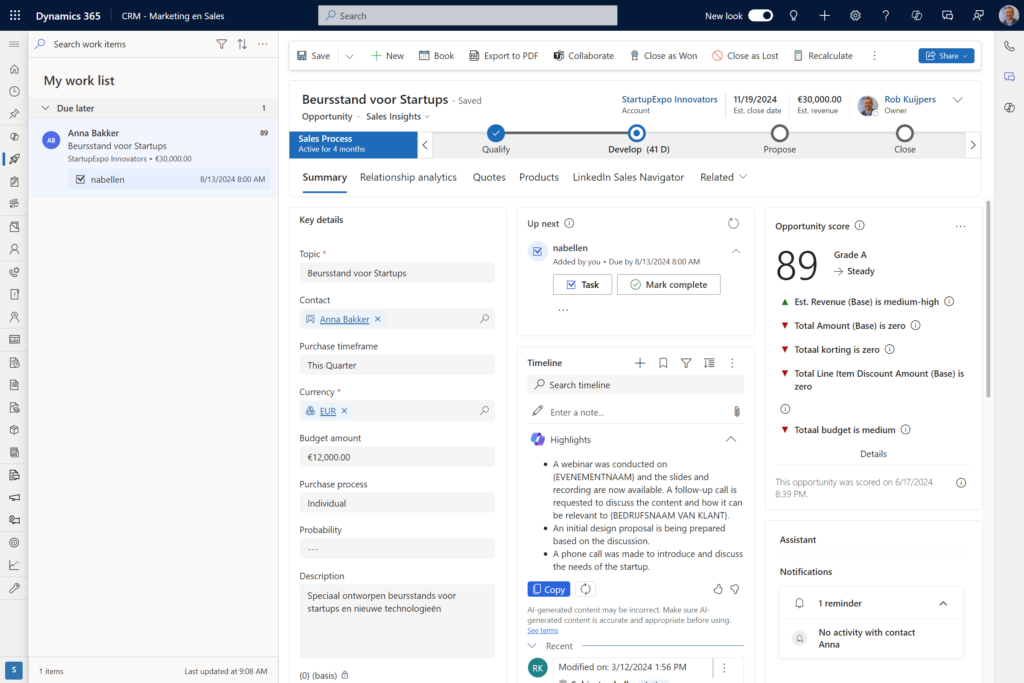
“Sell fast and efficiently” is often the message sales teams receive from the CCO. However, salespeople spend valuable time identifying the best customers in their customer list, having to go through multiple sources to determine who, when, and how to contact. To help salespeople save time, the sales accelerator in Dynamics 365 Sales provides a tailored experience, allowing them to minimize the time spent searching for the next best customer. The sales accelerator gathers information from multiple sources within your CRM system and helps salespeople sell smartly by building a strong and prioritized pipeline (consisting of leads and opportunities), providing context, and displaying automated recommendations throughout a sales trajectory, helping to speed up the sales process. With the sequence manager, activity sequences can be configured for salespeople to help them prioritize their daily activities.

Predictive Lead and Opportunity Scoring

Leads and opportunities are captured and followed up in large numbers in the CRM system. It’s essential to give the right attention at the right time to the right lead or opportunity. Thanks to built-in predictive AI models, a marketing or sales employee knows exactly when that moment has arrived. The captured information for a lead or opportunity is combined with historical data on when a lead or opportunity is converted or successfully closed. All this data is automatically fed into the AI model, which then assigns scores to the leads and opportunities. This allows a user to see exactly how many points a lead or opportunity has, what the trend is, and when the lead or opportunity is likely to be successful. This is the moment when the marketer or salesperson takes action.

Relationship Analysis

Relationship analysis uses the history of a salesperson’s activities with a contact or account and calculates KPIs based on their interactions. The KPIs are available at various levels, such as contact, account, opportunity, and lead. The graphical representation of the KPIs helps you quickly identify relationships that need attention and which KPIs need to be improved to strengthen these relationships. Relationship analysis helps salespeople and sales managers answer questions such as:

  • Do we have a good relationship with the customer?
  • How much time have we spent with our customer?
  • When was the last time we contacted them?
  • When should we contact them again?
  • How many emails and meetings have we exchanged?
  • What is the customer’s response rate?
  • How many activities were initiated by the customer?
  • How long does it take for our team to respond?
  • How long does it take for the customer to respond?

The key to success for a successful sales team, and therefore higher revenue, starts with providing an innovative CRM system to your disciplined salespeople. Give them the tools to increase their productivity, give them the data to gain insights, and provide them with convenience so they can focus entirely on their customers.