
The key to success in the modern sales world
The most successful salespeople do not rely on chance. They are disciplined in building relationships, maintaining the sales pipeline, and automating processes. In this blog, we discuss how sales engagement can help make your daily routine more productive and boost your sales.
Why is Sales Engagement Important?
Sales engagement is not just a buzzword; it is an essential component of a company’s successful sales strategy. By actively and strategically communicating with customers, sales teams can achieve three very important things.
- Accelerate sales: By communicating quickly and relevantly with customers, they move faster through the sales funnel, allowing you to convince them to make a purchase more quickly.
- Build relationships: Strong and personalized communication helps in building long-term customer relationships.
- Increase revenue: An effective sales engagement strategy ensures higher revenue and greater customer satisfaction, securing long-term revenue.
Core Aspects
Now that you know why sales engagement is important, let’s walk you through the key elements.
Channel
Sales engagement utilizes all possible communication channels such as email, phone, social media, and face-to-face meetings, all with the goal of communicating with customers. The aim is to reach customers through the channel they prefer and to approach them at the right moments.
Message
Communicating can be done through many channels, but ultimately it’s about the message. It’s important that it contains valuable and relevant content. This could be product information, an invitation for a demo, a case study, or a customer success story. The goal is to provide customers with the information they need to make a purchase decision.
A crucial part of the message is personalizing the communication. This means understanding the customer’s unique needs and pain points and responding with tailored communication.
Balance
It’s crucial to find the right balance in how often and when you contact customers. Too much contact can be perceived as intrusive, while too little contact can lead to loss of interest. Sales engagement platforms help sellers find this balance by providing data and insights.
Technology
A CRM system like Dynamics 365 Sales has become indispensable for a successful sales team. Sales engagement is part of the Dynamics 365 Sales Enterprise license and includes several highly valuable features to support the three core aspects (channel, message, and frequency).
Business Card Scanner
To record communication with your customers in a CRM system, it’s convenient to have the contacts you’re interacting with available in CRM. While you can manually enter contacts, you can also use the built-in business card scanner in the mobile app. Simply scan the card, and the text is automatically converted into the appropriate fields for a contact person.
Email Engagement
With email engagement, you can send emails directly from Dynamics 365 Sales. By simply creating a new email interaction, you can send an email right away. Personalized templates allow you to convey the right message. But that’s not all. You can track the recipient’s activity and set reminders if an email hasn’t been opened or answered. Additionally, you gain complete insight into the recipient’s interaction with your email, including how often the email has been viewed and whether attachments have been clicked.
Auto Capture
This feature helps you automatically record activities such as emails and meetings (found in Outlook) and display them on the Dynamics 365 Sales timeline. Auto capture recognizes relevant emails and meetings in your personal Outlook account and shows them as suggestions on the timeline of the corresponding record in Dynamics 365 Sales. Initially, automatically captured activities are only visible to you. You can choose to track these activities, making them visible to the entire sales team. This functionality works seamlessly with your existing Exchange and Outlook accounts, eliminating the need for manual entry. Additionally, you gain insight into your customers’ interactions, seeing exactly if a sent email has been opened, read, and whether an attachment has been opened. If you haven’t received a response to a sent email, you’ll get a subtle notification in your CRM system.
(Advanced) Proactive Assistant
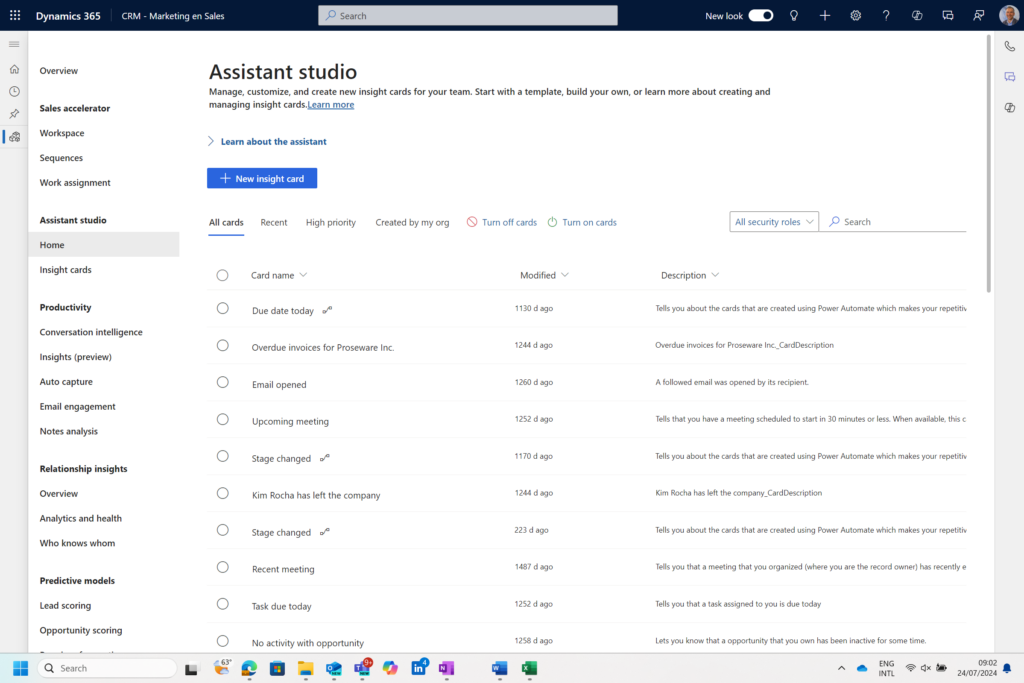
The standard proactive assistant comes with a set of ready-to-use notification cards that you can configure according to your preferences. For example, if you haven’t had contact with a customer for a while, if a sales opportunity is nearing its closing date, or if you haven’t received a response to a sent email. The most requested notifications have been made available by Microsoft by default. With the advanced proactive assistant, you can not only choose which notifications you want to see, but you can also design them yourself. You do this from the Assistant Studio. You create a custom notification card with the help of Power Automate. This allows you to use any important event or date as a notification for the user. By utilizing Power Automate’s connectors, you can even create notifications based on events in external applications.
Sales Accelerator
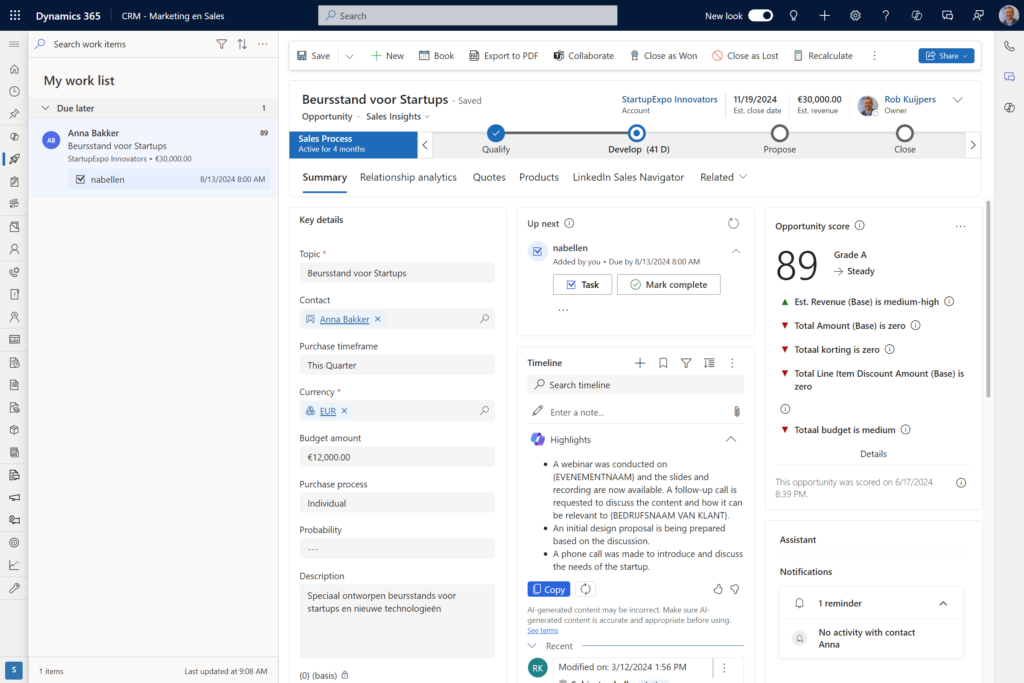
“Sell fast and efficiently” is often the message sales teams receive from the CCO. However, salespeople spend valuable time identifying the best customers in their customer list, having to go through multiple sources to determine who, when, and how to contact. To help salespeople save time, the sales accelerator in Dynamics 365 Sales provides a tailored experience, allowing them to minimize the time spent searching for the next best customer. The sales accelerator gathers information from multiple sources within your CRM system and helps salespeople sell smartly by building a strong and prioritized pipeline (consisting of leads and opportunities), providing context, and displaying automated recommendations throughout a sales trajectory, helping to speed up the sales process. With the sequence manager, activity sequences can be configured for salespeople to help them prioritize their daily activities.
Predictive Lead and Opportunity Scoring
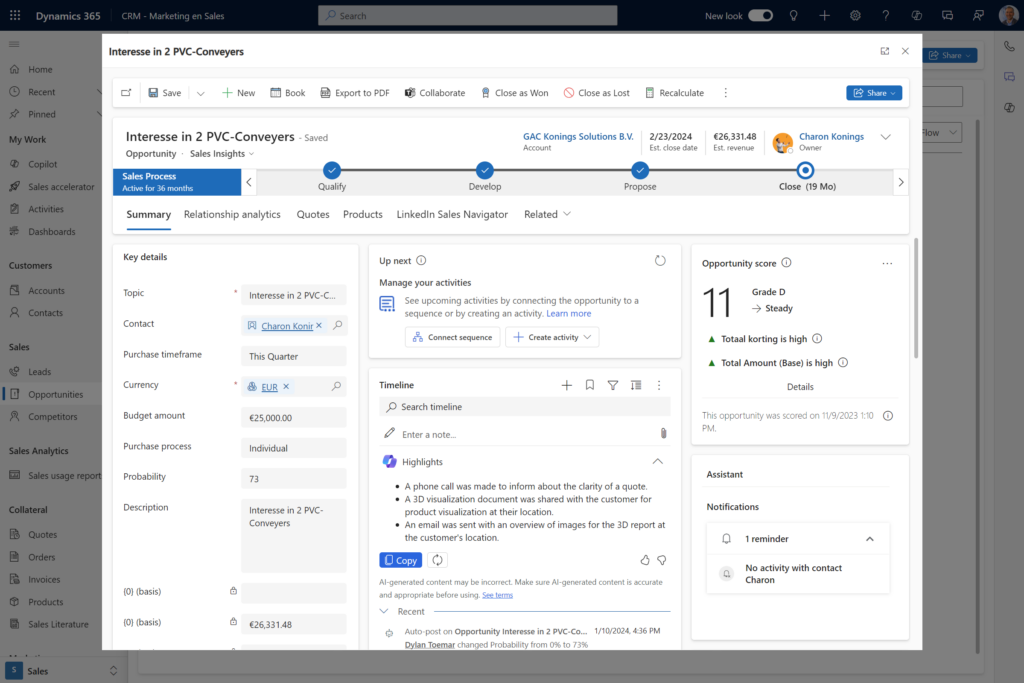
Leads and opportunities are captured and followed up in large numbers in the CRM system. It’s essential to give the right attention at the right time to the right lead or opportunity. Thanks to built-in predictive AI models, a marketing or sales employee knows exactly when that moment has arrived. The captured information for a lead or opportunity is combined with historical data on when a lead or opportunity is converted or successfully closed. All this data is automatically fed into the AI model, which then assigns scores to the leads and opportunities. This allows a user to see exactly how many points a lead or opportunity has, what the trend is, and when the lead or opportunity is likely to be successful. This is the moment when the marketer or salesperson takes action.
Relationship Analysis
Relationship analysis uses the history of a salesperson’s activities with a contact or account and calculates KPIs based on their interactions. The KPIs are available at various levels, such as contact, account, opportunity, and lead. The graphical representation of the KPIs helps you quickly identify relationships that need attention and which KPIs need to be improved to strengthen these relationships. Relationship analysis helps salespeople and sales managers answer questions such as:
- Do we have a good relationship with the customer?
- How much time have we spent with our customer?
- When was the last time we contacted them?
- When should we contact them again?
- How many emails and meetings have we exchanged?
- What is the customer’s response rate?
- How many activities were initiated by the customer?
- How long does it take for our team to respond?
- How long does it take for the customer to respond?
The key to success for a successful sales team, and therefore higher revenue, starts with providing an innovative CRM system to your disciplined salespeople. Give them the tools to increase their productivity, give them the data to gain insights, and provide them with convenience so they can focus entirely on their customers.